Online voting for UNM: 9,378 eligible voters, 55 ballots, zero issues
Stunning results
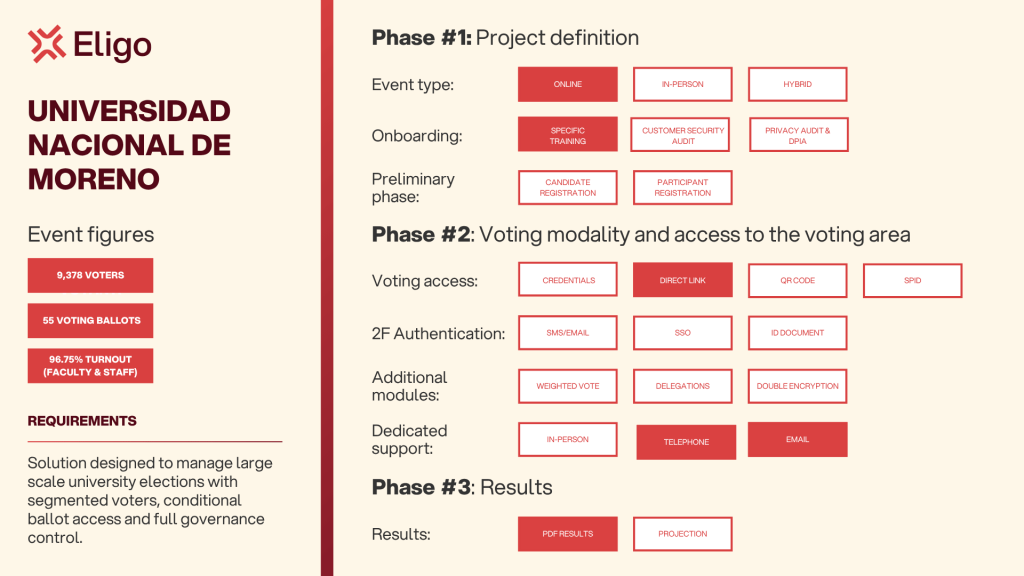
- 9,378 eligible voters (358 faculty, 8,897 students, 123 administrative staff)
- Turnout: 96.37% (faculty), 96.75% (administrative staff)
- Voting period: 29 October – 1 November 2025
- Voting method: fully online election
- Key achievement: multi-segment university election managed with 55 ballots and differentiated voting paths
Challenge: managing multi-level university elections at scale
The Universidad Nacional de Moreno, a public university in Argentina, required a large scale university online voting setup capable of handling heterogeneous voter groups with different roles, rights, and ballot access rules. The election involved three distinct constituencies: faculty, students, and administrative staff, each with specific governance requirements.
Operational complexity was driven by several factors. First, the total electorate exceeded 9,000 participants. Second, the election structure required multiple concurrent voting processes, including 27 ballots for faculty, 27 for students, and a dedicated ballot for administrative staff. Third, each voter needed access only to relevant ballots after participating in the election of the superior council.
From a governance perspective, the university needed to ensure strict separation of voter identity and vote, controlled access to ballots based on eligibility, verifiable and auditable results, and secure distribution of voting credentials.
The risk profile included potential inconsistencies in ballot access, scalability constraints during peak participation, and the need to maintain integrity across multiple electoral workflows.
This context made large scale university online voting a structural requirement for process integrity in large scale university online voting scenarios.
Our solution: conditional ballot access and governance control
The project was structured around a full outsourcing model for a university-wide election involving over 9,000 eligible voters within a large scale university online voting model. This ensured centralized execution and control across all electoral processes.
A key element of the implementation was the voting logic. All voters first participated in the election of the superior council. This initial vote was followed by access to additional department-level ballots, meaning that each voter was then directed only to the ballot(s) relevant to their specific academic unit. This conditional access model ensured strict governance control and controlled ballot access paths.
The operational delivery included:
- Dedicated onboarding and training for administrators
- Structured ballot configuration across three electoral groups
- Validation phase through controlled testing and simulations
- Import and management of voter lists by segment
- Configuration of conditional ballot access per user
- Real-time monitoring of participation and voting activity
- Multi-channel support via phone and email
Voter access and communication were structured through a direct email-based model. Each voter received a personalized voting link, eliminating friction and avoiding complex authentication flows.
Communication included:
- access instructions
- defined voting timelines
- automated confirmation through voting receipt emails
The introduction of automatic voting receipt emails reinforced transparency and process clarity.
The solution was structured around three pillars:
- Governance control: segmentation of voters and conditional ballot access
- Process management: centralized configuration of electoral events
- Customization: tailored communication flows and voting experience
From a technical standpoint, the system ensured anonymization of voting preferences at client level, separation between identity and vote, uniqueness of the vote, and auditability through logged operations and signed reports.
Eligo’s security and compliance framework aligns with ISO 27001, ISO 27017, ISO 27018. Voting preferences are anonymized and encrypted at the moment of submission, ensuring no traceability between voter and vote.
This architecture supports large scale university online voting scenarios with high governance complexity.
Results: how the university achieved high participation and controlled execution
The election delivered measurable outcomes across participation, operational efficiency, and governance control within a large scale university online voting framework.
Turnout exceeded 96% for faculty and administrative staff, confirming strong adoption among key institutional stakeholders.
The system successfully managed 9,378 eligible voters, 55 ballots across multiple electoral processes, and differentiated voting paths based on role and department in a large scale university online voting environment.
- Accessibility Direct link access enabled participation without technical barriers. Cross-device compatibility supported voting from any location.
- Transparency Automated voting receipts provided immediate confirmation. Results generated in PDF format ensured auditability.
- Efficiency Centralized management reduced administrative workload. Real-time monitoring enabled immediate issue resolution.
This case confirms that large scale university online voting enables scalable, secure, and structured governance in complex academic environments.
Summary Data
| Indicator | Value |
| Eligible voters | 9,378 |
| Faculty turnout | 96.37% |
| Administrative turnout | 96.75% |
| Students who voted | 2,824 |
| Voting period | 29 Oct – 1 Nov 2025 |
| Voting method | Online |
| Number of ballots | 55 total |
| Average ballots per voter | ~2 |
| Delivery method | Email voting link |
| Results format |
Client: university context and governance scope
Universidad Nacional de Moreno is a public university with a multi-stakeholder governance structure involving faculty, students, and administrative staff.
The election of the superior council represents a central decision-making process, requiring controlled participation, differentiated voting rights, and strict governance compliance.
This case demonstrates how a complex, multi-stakeholder university election can be executed with full control, clarity, and reliability through a structured large scale university online voting approach.
By implementing conditional ballot access and centralized process management, the university was able to manage a high number of voters, multiple ballots, and differentiated voting rights within a single, coherent large scale university online voting system. This approach provides a scalable and replicable model for institutions managing complex governance structures.
The client commented after the election:
“First of all, I wanted to thank the whole team for the support and assistance in carrying out the University elections. It is a great joy for everyone that the electoral process went well. I would like to thank you for your support, as well as your team’s and Anna’s, throughout the entire process. Everything went very well, and I wanted to let you know. The whole process went smoothly without any issues.“